
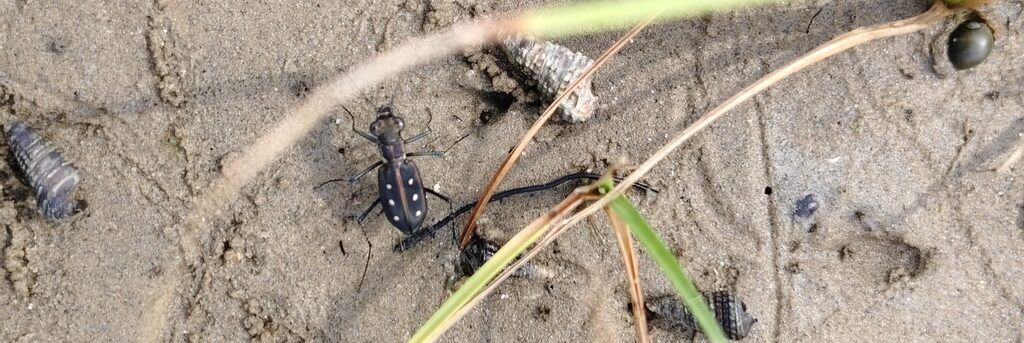
The Six-Legged Tigers in Your Backyard: Why the World’s Fastest Insects Are Rewriting the Rules of Conservation
Imagine a predator so relentlessly fast that it literally runs itself blind.
Meet the Tiger Beetle. Gram for gram, these fierce, metallic-hued insects are among the fastest creatures on Earth, moving so rapidly that their brains cannot process light fast enough, forcing them to momentarily stop mid-chase just to let their vision catch up. But they aren’t just fascinating evolutionary marvels – they are the ultimate “ecological canaries in the coal mine.” Because they are hyper-sensitive to changes in temperature, soil quality and human disturbance, their sudden disappearance is a flashing red siren that an entire ecosystem is collapsing.
For decades, studying these creatures was split into two separate worlds: the academic scientists in ivory towers and the passionate amateur naturalists out in the mud. These walls are coming down.
The IUCN Species Survival Commission (SSC) has officially greenlit the global Tiger Beetle Specialist Group (TBSG)! Driven by a founding network of 46 members across 14 countries currently, this group is pioneering a massive shift toward inclusive, community-driven citizen science.
At The Naturalist School (TNS), we are incredibly proud to be helping lead this charge. Our very own Ram Dayal Vaishnav has stepped up as the global Subgroup Leader and Red List Authority for the Red List Protocols Subgroup. Here is a look behind the scenes of our recent international strategy meeting and, more importantly, how you can actively participate in this global conservation movement.
💡 The Terms You Need to Know (Before We Dive In)
To understand why this is a massive milestone, it helps to understand a few key concepts that our global team is using to protect biodiversity:
- Bioindicators: Organisms whose health and population numbers tell us exactly how healthy a specific environment is. If a beach or grassland is degraded, tiger beetles are the first to vanish.
- The IUCN Red List: The world’s most comprehensive inventory of the global conservation status of biological species. A species placed here gains vital international legal protection.
- Cybertaxonomy: The practice of utilizing advanced online tools, high-resolution macro photography and digital sharing to classify and describe new species remotely, overcoming physical and geographic boundaries.
- Species Distribution Models (SDMs): Advanced computer algorithms that combine species sightings with climate data to predict exactly where animals will move as the planet warms.
🤝 Breaking the Elitism: The Power of the “Cicindelophile”
The foundational core of the TBSG is built on a radical idea: true conservation cannot exist in a “scientists-only” club. As professional entomologists increasingly pivot toward complex laboratory disciplines like spatial modeling, the critical work of hands-on fieldwork and discovering new species has largely remained with non-professionals.
Did you know? Out of the approximately 2,900 recognized tiger beetle species worldwide, the vast majority were originally discovered and described by historical amateurs or the contemporary community of self-taught enthusiasts, affectionately known as “cicindelophiles”.
The TBSG is actively dismantling the old “us vs. them” academic hierarchies. We are uniting rigorous laboratory science with the real-time, boots-on-the-ground observations of everyday citizen scientists, amateur photographers and nature lovers.
📊 Case in Point: The Success of Tiger Beetle Watch India
Look no further than our close collaborator Sharan V., who founded Tiger Beetle Watch India. By giving amateur naturalists a clear focus on the iNaturalist platform, this single initiative has mobilized over 1,100 observers and generated nearly 9,000 georeferenced records. The result? Regular people out on weekend walks have successfully (almost) rediscovered four to five species that hadn’t been seen by science since their original descriptions decades ago!
🚀 Crucial Global Updates: What We Are Tackling Right Now
During our latest international strategic meeting, the TBSG laid out actionable pathways to scale our impact across five specialized pillars:
1. Accelerating Red List Assessments
We are racing against time to map out species vulnerability. Thanks to intensive volunteer efforts, many of Indian tiger beetle species are now assessed on the IUCN Red List, and our team is on track to assess every single US endemic species by early 2027. To ensure our data holds up to strict IUCN scrutiny, core members – including Amila Sumanapala from Sri Lanka and Ram Dayal Vaishnav from India – have passed the rigorous IUCN Global Assessor certification and are acting as Red List Authority for the group to coordinate with the IUCN SSC & Red List Unit.
2. Leaping Over Bureaucracy with Cybertaxonomy
Stringent national laws regarding the collection and international shipping of physical insect specimens can often stall vital conservation research for years. To bypass this red tape, experts like Jürgen Wiesner (Germany) and André Silva Roza (Brazil) are co-describing new species entirely via cybertaxonomy – using meticulously detailed macro photographs of morphological characters shared digitally. Meanwhile, we are also exploring partnering with organizations and institutions to fund local DNA barcoding to study hidden species complexes independently.
3. Predictive Climate Modeling
Climate change is creating an “escalator to extinction,” pushing mountain-dwelling species higher up in altitude as temperatures rise. Few of our members are building Species Distribution Models (SDMs) to project landscape-scale habitat suitability across the Palearctic and Himalayan regions, giving us a roadmap of where to focus limited funding before habitats disappear.
4. Global Rearing & Wild Reintroductions
Led by Dr. Deokjea Cha in South Korea, a highly cooperative network spanning Japan, Brazil, Canada, the UK and the US is perfecting ex situ (captive) larval rearing programs. By openly sharing operational breakthroughs and tank setups, these institutions are systematically fixing historical husbandry mistakes and maximizing the success rates of reintroducing endangered beetles back into the wild.
🛠️ How You Can Get Involved (No PhD Required!)
We want our collective impact to be as diverse as the ecosystems we are trying to save. The IUCN SSC is actively encouraging to involve more youth and women participants in global leadership and field roles.
We are currently developing a centralized website hub and communication tools for the Specialist Group. This hub will host free, open-access digital field guides, pocket brochures for field tracking, and a direct portal to get involved with upcoming international BioBlitz events.
Here is how you can jump in right now:
- Become an Observer: Download the iNaturalist app, head out into your local riverbanks, sandy beaches, or forest paths, and start photographing tiger beetles. Your snapshot could be a vital new range extension or a species rediscovery.
- Join a Subgroup: We are actively seeking passionate individuals (naturalists, educators, designers, writers, and scientists) to join our specialized pillars:
- 🔴 Red List Protocols Subgroup
- 🗺️ Distribution & Taxonomy Subgroup
- 🌱 Conservation & Management Subgroup
- 📣 Education & Outreach Subgroup
- 🌏 Regional Subgroups
💬 Let’s Build the Future of Conservation Together
Whether you are a university professor, a student, a professional photographer, or simply someone who cares about the health of our planet, your voice and your eyes are needed in the field.
Are you ready to join the TBSG network or take part in our upcoming global Tiger Beetle Watch events? Drop a comment below or send us a direct message/email (at ram[at]naturalist[dot]school) to get plugged in! 💬👇
To stay updated on upcoming citizen science boot camps, free digital field guides, and World Tiger Beetle Day preparations, subscribe The Naturalist School updates (from the footer below).
Cover Image (Cicindela sexpunctata) Credits: @hareeshaas on iNaturalist
No Comments
Sorry, the comment form is closed at this time.